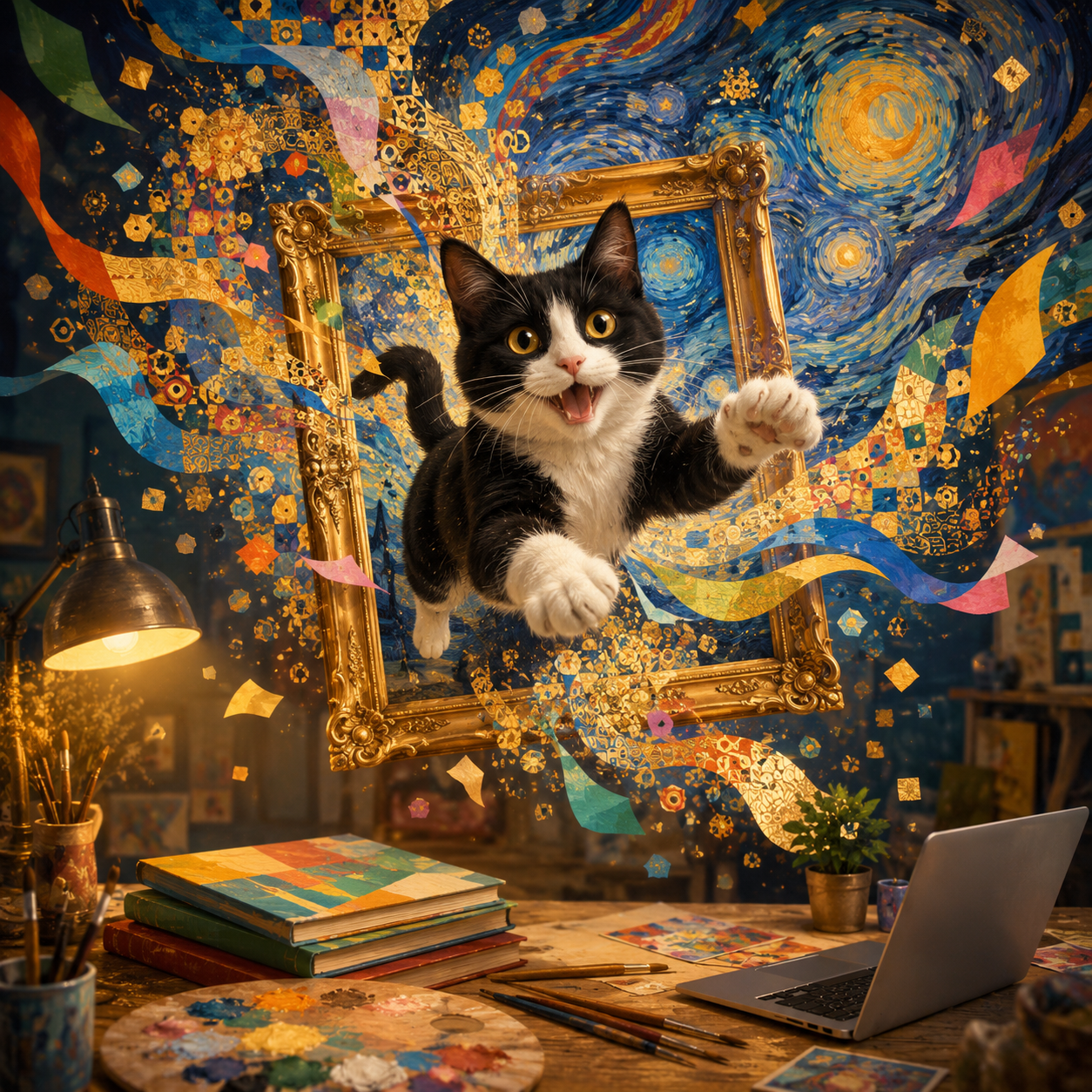
I ship software for a living. Backlogs, pipelines, the occasional 2 a.m. rollback. So the last thing I expected to hold in my hands this year was a children’s picture book with my name on the cover. Yet here we are — my first book is out, in four languages, and a cat is entirely to blame.
It started as a joke
The idea was almost too silly to say out loud: what if a cat jumped straight into a famous painting? Not a poster. The actual canvas. One curious tuxedo cat, one leap, and suddenly she’s standing in the middle of Bruegel’s village square while two kids dive in after her. Twelve masterpieces, arranged from Bruegel to Matisse, so the book quietly turns into a first little tour of art history without ever admitting it.
I couldn’t stop thinking about it. And when a software person can’t stop thinking about something, they do the reasonable thing: they start building it.
Building a book like it’s a product
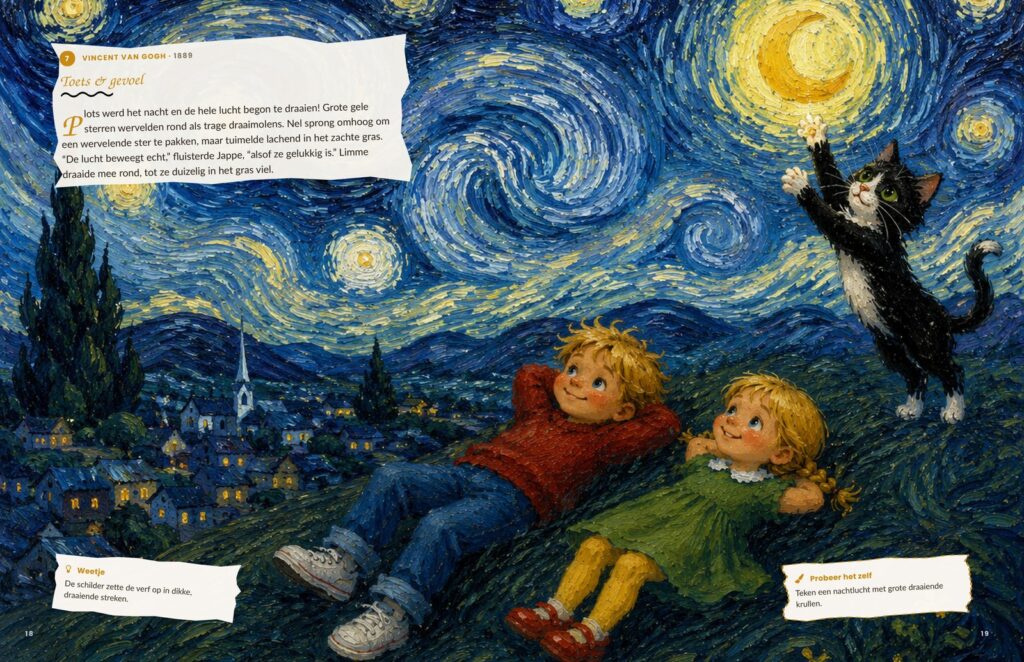
Turns out a picture book has a build pipeline too. Every spread became a little system: one big art idea, a read-aloud story, a fun fact, a “try it yourself”, and an original illustration painted in that master’s own technique — AI-assisted, art-directed by hand, never a reproduction. Text and art were composed with HTML and CSS and rendered straight to print-ready PDF. It felt suspiciously like front-end work, except the “browser” was a printing press and there was no hotfix after release.
And oh, the print details. Bleed is 3.175 mm, not 3. Text has to stay a quarter inch from the trim or the previewer politely refuses to let you continue. Full-bleed spreads that cross the spine look “wrong” in preview and perfectly fine in print. I learned all of this the way I learn everything — by getting it wrong first.
One cat, four names
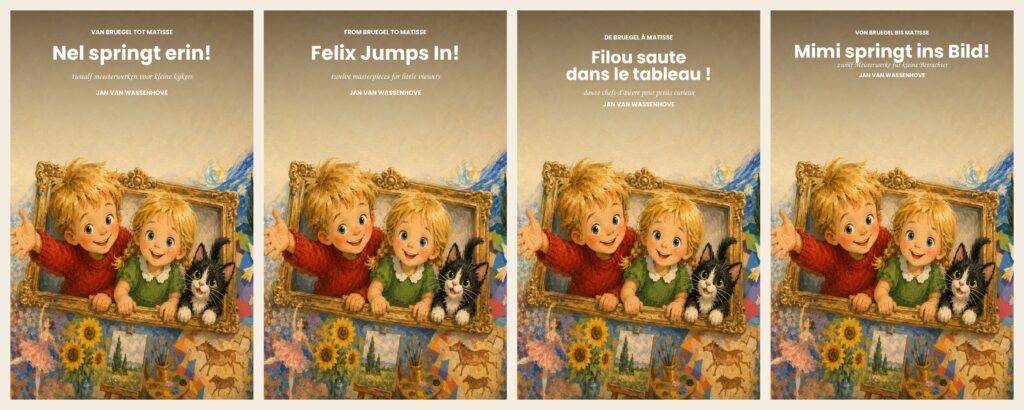
Then I got greedy and made it multilingual. Because a good cat travels, she changed her name at every border: Nel in Dutch, Felix in English, Filou in French, Mimi in German — the kids got local names too. Same adventure, four editions, four times the proofreading.
The final boss: KDP
Publishing on Amazon KDP is its own little dungeon. Trim sizes, premium colour, category trees that somehow don’t have an “art” box for a children’s art book, an AI-content disclosure, a proof copy, and that last, very deliberate click on Publish. I did Dutch first as a pilot, checked a printed proof, and then let the other three follow. Eight products — paperback and Kindle × four languages — went live.
Shipping software gives you a dashboard and a green checkmark. Shipping a book gives you a small cardboard box on your doorstep, a real object that a four-year-old can hold upside down. I’ll be honest: the box wins.
What it taught me
Mostly this: the discipline that ships software also ships stories. Break it into systems, sweat the boring specs, keep a locked style, review ruthlessly, and don’t be afraid to press publish. The tools were new; the mindset was the same one I use every day.
The book is out now on Amazon as paperback and Kindle, in all four languages. Flip through a free preview and pick your edition on the Children Books page. And if you spot the cat hiding on every spread — that was always the whole point.