
Direct Download Links
Last year, in a moment of questionable judgment and mild creative curiosity, I built a small experiment. It asked a very simple question:
What if every movie… was secretly a love story?
You typed in Die Hard and suddenly it wasn’t about terrorists and ventilation shafts anymore. It was about a man desperately trying to reconnect with the love of his life on Christmas Eve.
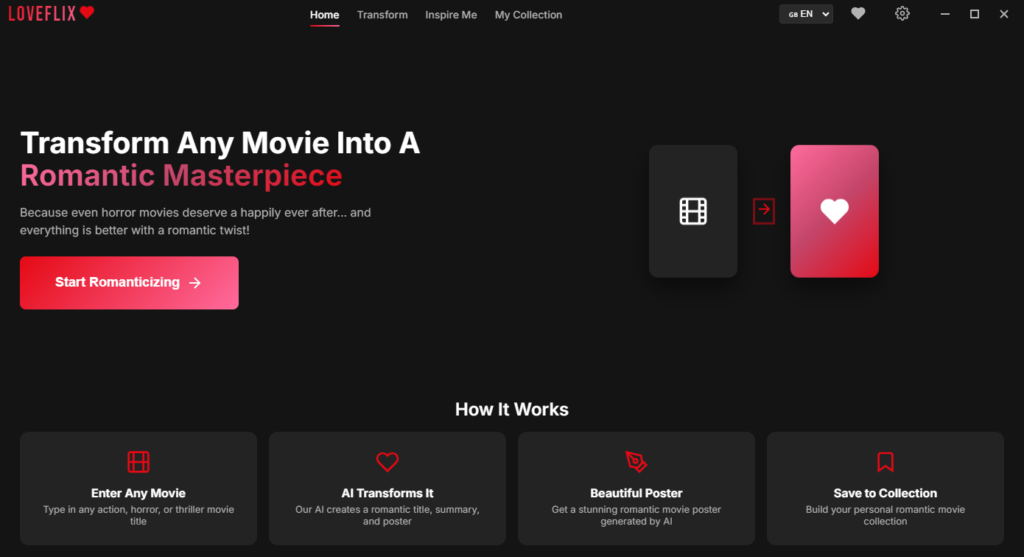
You entered Terminator and what emerged was not a dystopian AI apocalypse — but a misunderstood machine discovering vulnerability.
It was absurd.
But here’s the important part: it didn’t happen by itself.
You chose the movie.
You pressed the button.
You decided to reinterpret it.
The human was always in the loop.
Naturally, I decided the only reasonable next step was to turn it into a full desktop application — because when something is slightly ridiculous, the logical response is to engineer it properly.
The Glorious Overengineering of a Joke
The original LoveFlix was simple. A CLI. A prompt. A result.
You ran it. It romanticized. You laughed. But something happened.
The joke started revealing interesting things about AI, storytelling, and how easily we reinterpret narrative tone. With a few well-placed metaphors, even a post-apocalyptic wasteland can become an emotionally charged backdrop for longing.
So this year, LoveFlix received a full architectural rewrite. Not a small update. A complete transformation.
It is now a fully installable desktop application for macOS and Windows — wrapped in a dark, cinematic interface that looks suspiciously like Netflix… but with emotional instability.
The Moment It Became Dangerous
The turning point wasn’t the AI.
It was the collection view.
Because once LoveFlix could generate not just a romanticized movie — but an entire curated personal library — it stopped being a toy and became a persuasion tool.
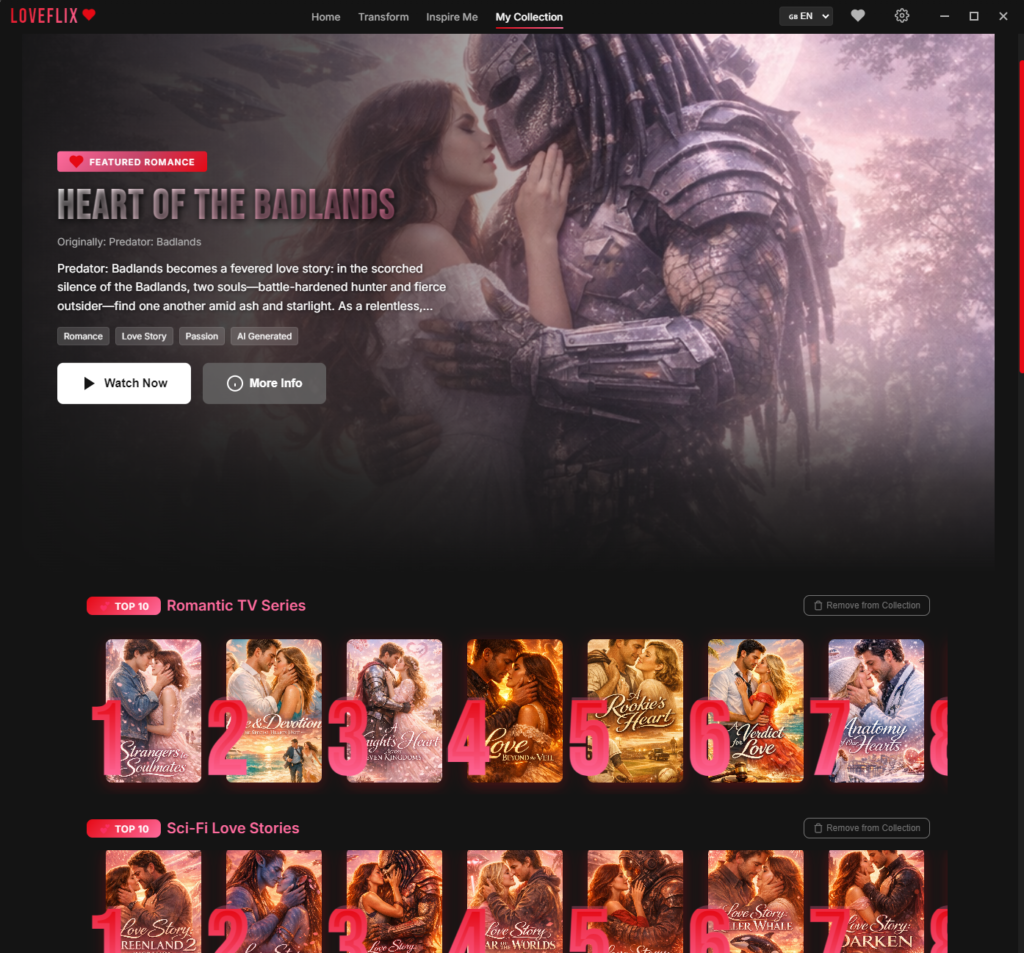
You can now discover real trending movies by country, romanticize entire Top 10 lists, build your own collection, and present it all in Netflix-style rows with hero banners.
It looks real.
Convincingly real.
And when your girlfriend sees a beautifully styled dark interface with a featured banner titled:
“Madly in Love Max: Fury of the Heart”
… you may, just may, win the evening.
The Art of Rewriting Reality
What fascinates me most about LoveFlix is not the interface, polished though it may be. It’s how easily genre bends.
With the right framing:
- A car chase becomes an urgent pursuit of affection.
- A monster becomes emotionally misunderstood.
- A war epic becomes a meditation on separation and longing.
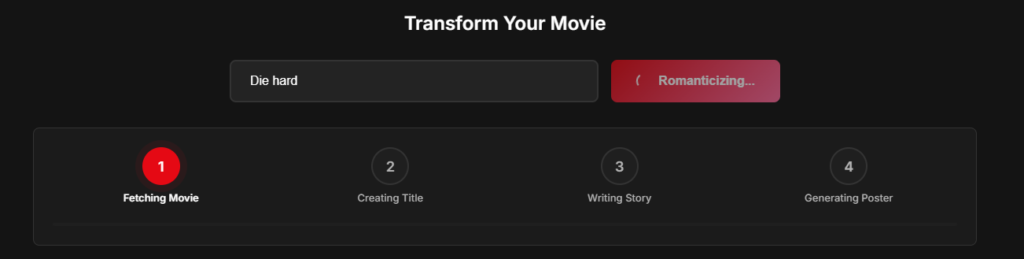
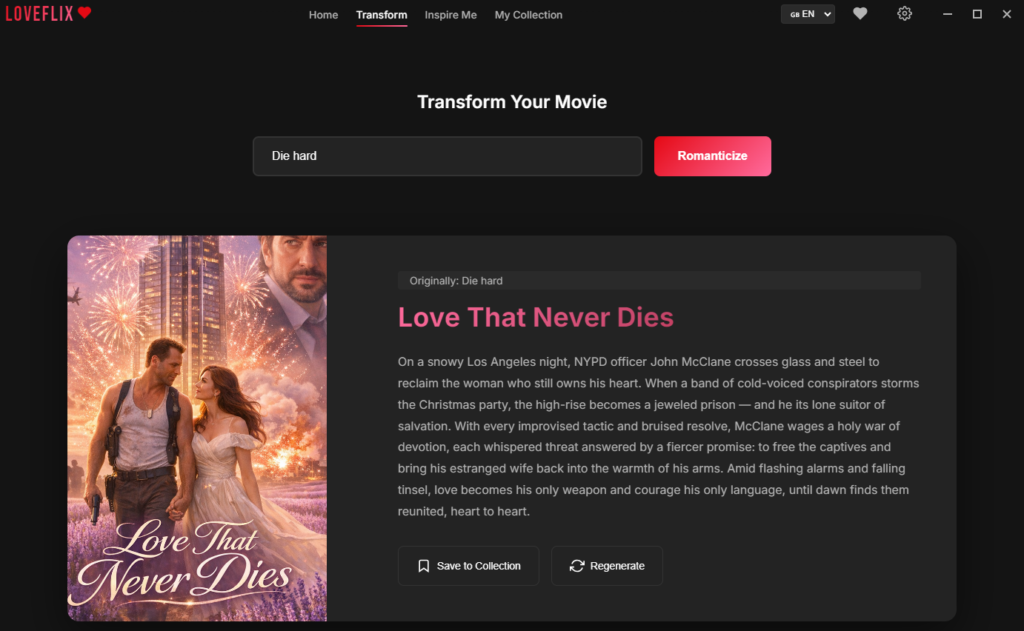
Nothing factual changes. The events remain. The explosions still happen. The villain still has a plan.
What changes is emphasis.
LoveFlix doesn’t offer a menu of tonal styles. It does one thing, unapologetically: it romanticizes. It reframes everything through a romantic lens.
And that constraint is interesting.
Because even with a single consistent perspective, meaning shifts dramatically. The same plot points take on a different emotional weight. The same dialogue suddenly feels softer, more intimate, sometimes absurdly sincere.
There’s something undeniably Monty Python about insisting that an explosion represents emotional growth.
But there’s also something instructive about watching how a single lens can transform interpretation so completely.
Human in the Loop — By Design
Throughout this evolution, one principle remained constant: the human stays in control.
You choose the movie.
You decide when to regenerate.
You curate the collection.
The system amplifies creativity. It does not initiate it.
That distinction is important.
AI systems are exceptionally good at reframing. They can amplify tone, bend context, exaggerate emotion, and make reinterpretation feel coherent and convincing. The more polished the output, the easier it becomes to forget that it is a transformation — not an objective truth.
LoveFlix keeps that transformation visible.
You are aware that you are manipulating the narrative. You are deliberately reinterpreting the story. The absurdity makes the mechanism transparent.
As AI systems grow more autonomous, the conversation about guardrails becomes inevitable. Not as rigid constraints that suffocate innovation, but as design decisions that preserve intent and accountability.
LoveFlix does not attempt to solve that broader challenge. It simply offers a playful environment in which you can feel the mechanics at work.
And sometimes, understanding power inside a joke is safer — and more enlightening — than encountering it for the first time in a boardroom.
Under the Hood (Yes, There Is a Hood)
Behind the romantic nonsense sits a properly structured desktop application. LoveFlix runs as a cross-platform Electron build, with a secure preload bridge, multi-model OpenAI integration, real-time TMDB discovery, persistent local collections, auto-update capabilities, and full internationalization support.
In other words, it’s technically serious software.
It just happens to generate emotionally unstable reinterpretations of action cinema.
Why Build This?
AI is often introduced in meeting rooms with a very specific tone.
We talk about efficiency, automation, productivity gains, governance models. Important conversations. Necessary conversations. No one wants their AI system to behave like an enthusiastic intern with access to everything and supervision from no one.
But something more subtle is happening beneath those discussions.
AI is not only automating workflows. It is shaping perception. It is influencing how information is framed, how products “speak,” how interfaces feel. It can soften a message, dramatize it, simplify it, exaggerate it, or make it sound reassuringly confident.
That shift matters.
LoveFlix began as a joke about turning action movies into romance. But it quietly reveals how fragile narrative framing really is. The events of the story don’t change. The explosions are still there. The villain still has a master plan. Yet the emotional interpretation can be completely different.
The mechanism that turns a dystopian thriller into a love story is the same mechanism that can reshape tone in far more serious domains.
That is not alarming — but it is powerful.
And power is most interesting when we can observe it safely.
A Valentine’s Day Survival Mechanism
Let’s be honest.
Valentine’s Day negotiations over movie choice are real.
One person wants explosions. The other wants emotional depth.
LoveFlix proposes a third path.
Keep the explosions. Add emotional depth. Rebrand aggressively.
Download & Explore
LoveFlix 2.0 is available as a desktop application for:
- Windows
- macOS
Source code and releases can be found here:
https://github.com/janvanwassenhove/LoveFlix
V1.0.0 release installables for mac and windows can be found at https://github.com/janvanwassenhove/LoveFlix/releases/tag/v1.0.0
Install it. Transform something inappropriate. Build a collection.
Observe how genre collapses under reinterpretation.
A Completely Serious Disclaimer
LoveFlix does not guarantee improved relationship outcomes.
It may cause:
- Referring to fight scenes as “expressions of unresolved intimacy”
- Concluding that world domination could have been avoided with a well-timed hug
- Reclassifying alien invasions as “interstellar communication breakdowns”
Use responsibly.
Or heroically.
A Slightly More Serious Note (But Not Too Serious)
There’s something fascinating hiding beneath the absurdity.
LoveFlix makes narrative elasticity visible. It shows how easily tone shifts, how quickly perception changes, how framing alters interpretation.
That’s amusing when we’re talking about action movies.
But the same mechanism appears in dashboards, customer journeys, decision-support systems, and digital assistants.
AI doesn’t just automate. It frames. And when framing becomes programmable, keeping humans consciously involved is not optional — it’s architectural.
LoveFlix doesn’t solve that challenge. It simply lets you experience it — safely, playfully, deliberately.
As we design the next generation of intelligent systems, the question is not only what they can generate — but who decides how the story is told.
Final Thought
Every movie can be romantic.
Even the ones that absolutely, definitively, categorically should not be.
And perhaps that says less about movies…
…and more about how easily we rewrite stories.
Even our own.
Direct Download Links