Code. Play. Repeat.
PiBeat is a live-coding music environment for people who prefer writing rhythm over dragging rectangles.
Inspired by the original Sonic Pi experience, PiBeat combines real-time music coding, modern desktop engineering, creative experimentation, and AI-assisted workflows into a single instrument.
Write a few lines of code.
Press play.
Listen to the machine answer.
Sometimes with a beat.
Sometimes with chaos.
Occasionally with both.
Built with Rust, Tauri, React, and a growing obsession with musical feedback loops, PiBeat is designed to keep the distance between idea and sound as small as possible.
Not a DAW pretending to be a code editor.
Not a code editor pretending to be a synthesizer.
Something in between.
A Workspace Built for Musical Experiments
PiBeat is designed around immediacy.
The editor is not a side panel hidden behind menus and settings. It is the instrument itself.
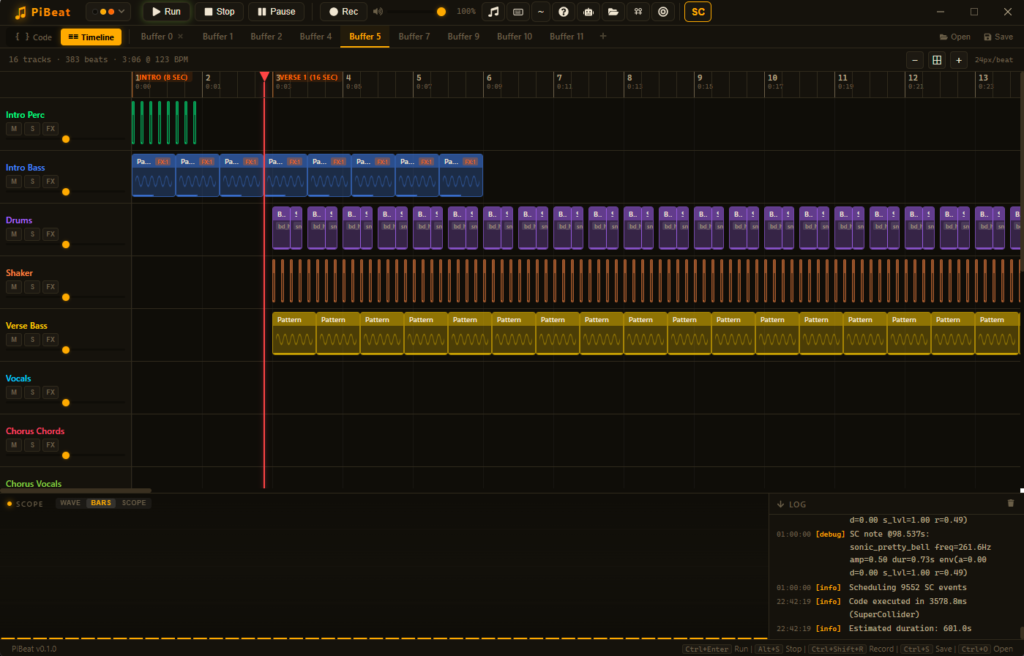
Multiple buffers, live execution, waveform feedback, built-in synths, samples, scales, effects, and timeline visualisation work together to keep you inside the creative loop instead of fighting the software.
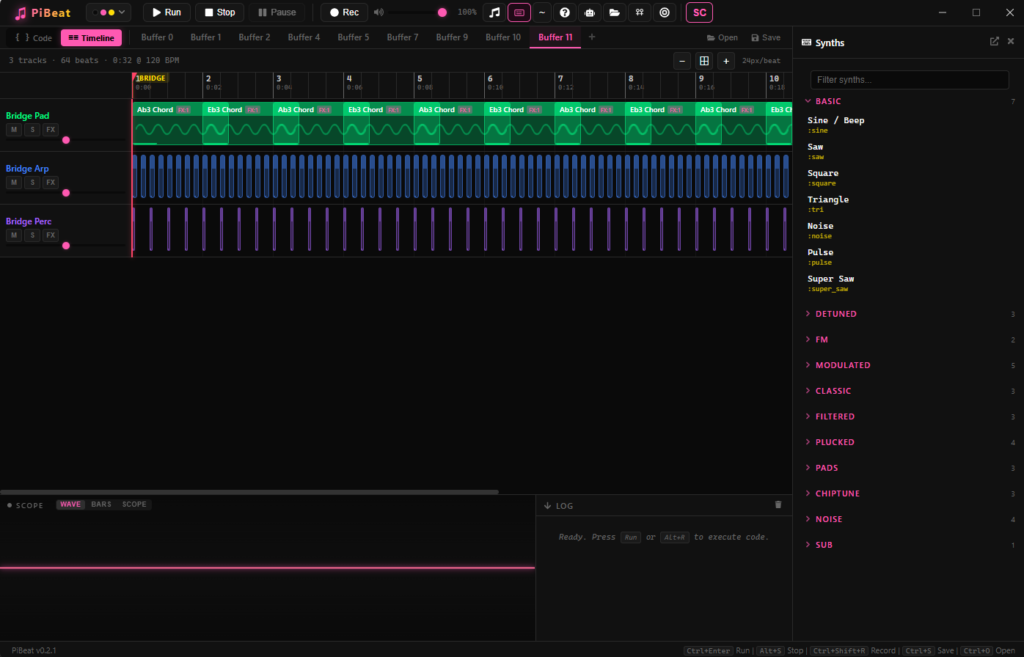
The main PiBeat workspace.
Write music as code, execute it instantly, inspect the result, and iterate before the idea has time to escape.
Real-Time Music Coding
Live coding is a strange and wonderful thing.
You are not arranging clips.
You are having a conversation with time.
PiBeat embraces that workflow by providing fast execution, Sonic Pi-inspired syntax, pattern generation, effects routing, and real-time audio feedback.
AI Chat Interface & samples overview
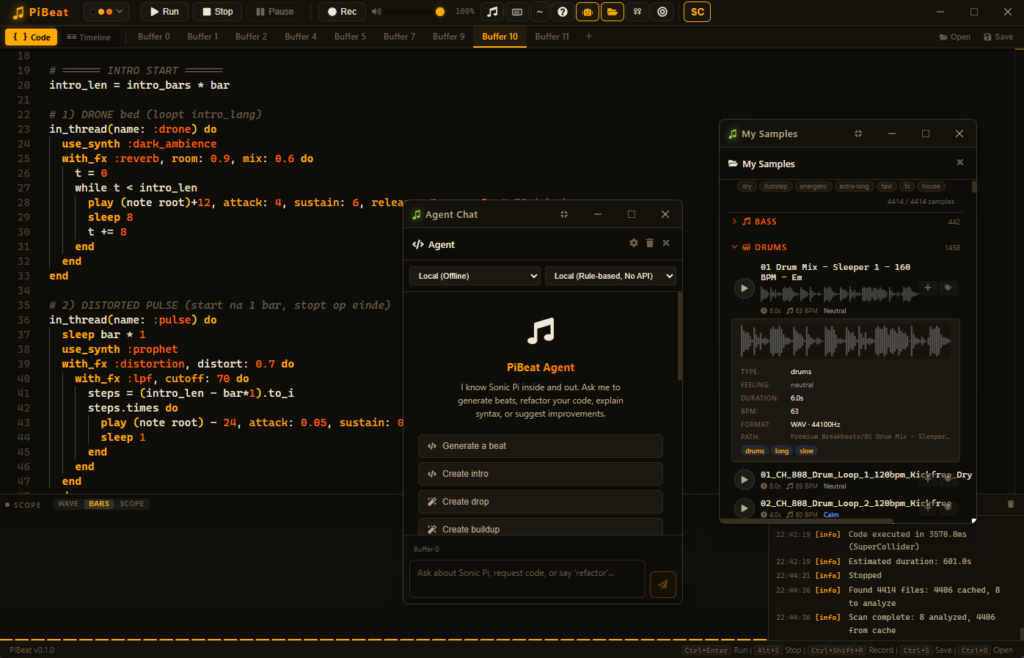
From code to sound in seconds.
The goal is simple: reduce friction until experimentation becomes the default behavior.
Built by Testing the Instrument, Not Just the Interface
One of the goals behind PiBeat is fidelity.
Not just visual fidelity.
Behavioral fidelity.
Parser validation, event snapshots, fixture testing, audio comparisons, synth behavior checks, and Sonic Pi parity investigations help ensure that the instrument behaves honestly when the music starts.
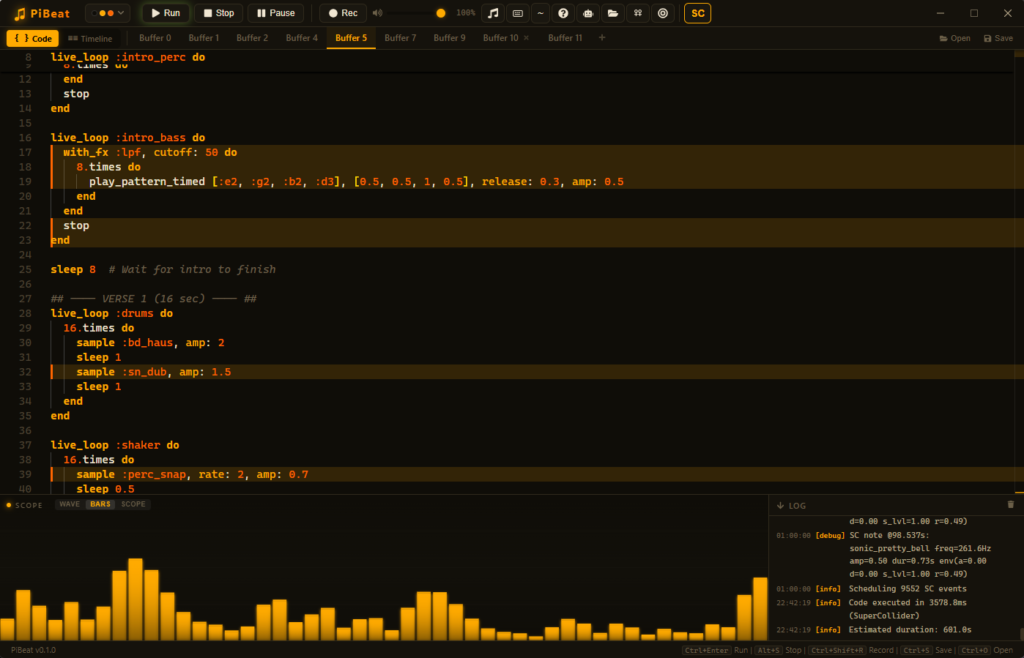
Under the hood, PiBeat is continuously challenged against expected musical behavior.
Because “close enough” sounds surprisingly wrong when speakers are involved.
AI as a Collaborator, Not a Mascot
PiBeat includes AI-assisted music generation and code assistance, but the goal is not to replace creativity.
The goal is to shorten the distance between:
“I have an idea.”
and
“That actually sounds interesting.”
Generate rhythms, reshape patterns, explore variations, or use AI as a musical sparring partner when inspiration decides to take a coffee break.
Creative assistance directly inside the workflow.
Less prompt theatre. More music.
The Journey Has Just Started
PiBeat is still evolving.
New synths, deeper Sonic Pi compatibility, improved audio fidelity, richer live-coding workflows, smarter creative assistance, and new experimental ideas are constantly finding their way into the project.
This first release is not the final destination.
It is the opening chord.